
Blog
Obviousness in Patent Law
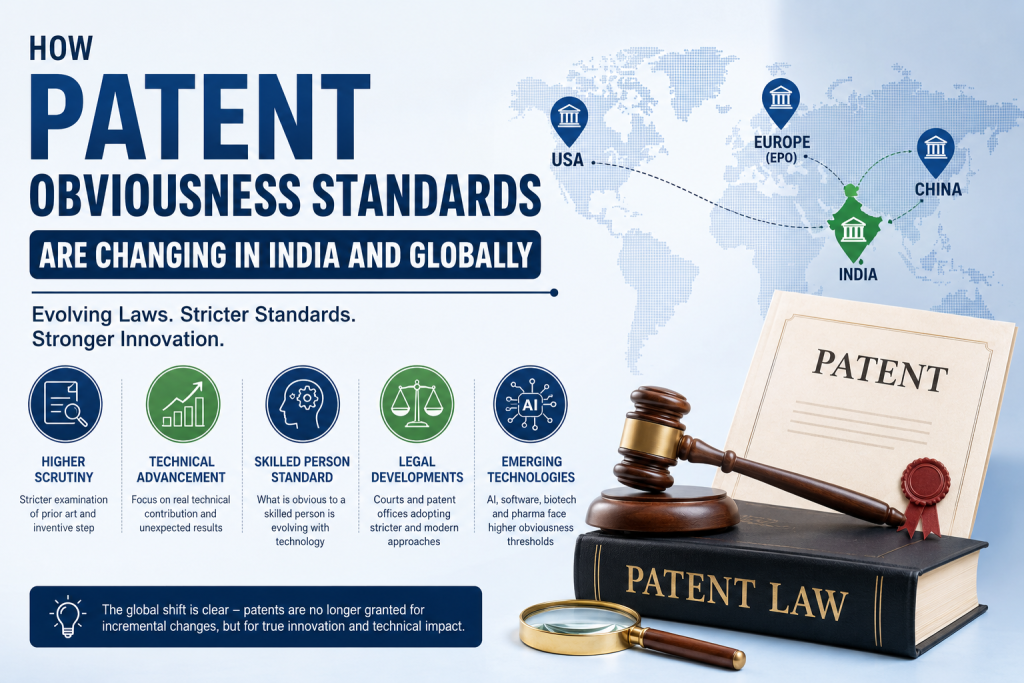
Patents are granted only to inventions that are new, useful, and non-obvious. Among these requirements, “obviousness” has become one of the most debated and evolving standards in global patent law. Patent offices and courts across the world are now applying stricter and more technology-focused approaches to determine whether an invention truly deserves patent protection.
In India and globally, the concept of obviousness—also known as “inventive step”—is continuously evolving due to rapid innovation in artificial intelligence, biotechnology, software, pharmaceuticals, and engineering sectors. Understanding these changing standards is essential for inventors, startups, researchers, and businesses seeking stronger patent protection.
What is Patent Obviousness?
Patent obviousness refers to whether an invention would be easily predictable to a “person skilled in the art” based on existing prior knowledge or prior art. If the invention appears to be a simple modification or combination of existing technologies, it may fail the inventive step requirement.
In India, Section 2(1)(ja) of the Patents Act defines inventive step as a feature involving technical advancement, economic significance, or both, which makes the invention non-obvious to a skilled person.
Why Obviousness Standards Are Becoming More Important
Patent offices worldwide are witnessing a rapid increase in patent applications, especially in emerging technologies. Because of this growth, authorities are becoming stricter in evaluating whether inventions are truly innovative or merely incremental developments.
Today, patent examiners focus heavily on:
- Technical advancement
- Unexpected results
- Real-world problem-solving capability
- Commercial significance
- Combination of prior art references
- Functional improvement over existing technology
This shift is designed to prevent weak patents and encourage genuine innovation.
When Should You Send a Copyright Notice?
You should take action immediately if you notice:
- Copy-paste of your blog or website content
- Unauthorized use of your images or videos
- Piracy of software, music, or digital products
- Republishing your content without credit
- Commercial use of your work without permission
Delaying action can weaken your legal position and increase damage.
Evolution of Obviousness Standards in India
India’s patent system has gradually moved toward stricter and more internationally aligned standards for inventive step analysis.
1. Strong Judicial Interpretation
Indian courts increasingly examine technical evidence and scientific advancement while determining inventive step. Courts now require applicants to demonstrate substantial technical contribution instead of routine modifications.
One of the landmark principles in Indian patent law came from the case:
Novartis AG v. Union of India
The Supreme Court clarified that minor changes to known pharmaceutical substances are insufficient unless they show enhanced therapeutic efficacy. This decision significantly influenced how inventive step and patentability are evaluated in India.
India’s Strict Approach Toward Incremental Innovation
India has become globally recognized for its strict scrutiny of secondary and incremental patents, especially in pharmaceuticals.
Section 3(d) of the Indian Patents Act acts as an additional safeguard against “evergreening,” where companies attempt to extend patent monopolies through small modifications. Indian authorities now demand stronger evidence of therapeutic or technical improvement.
This approach has influenced global discussions about balancing innovation incentives and public access to medicines.
Changing Standards for Software and AI Patents in India
India is also modernizing its approach toward computer-related inventions and AI-based technologies.
The Indian Patent Office recently introduced updated Computer Related Inventions (CRI) Guidelines that provide a more structured framework for examining software and emerging technology patents. These guidelines reflect judicial developments and international practices.
The revised framework focuses on:
- Technical effect
- Hardware integration
- Industrial application
- Real technical contribution
- Exclusion of abstract algorithms
This indicates that India is gradually becoming more receptive to technology-driven innovations while maintaining strict standards against abstract software claims.
How the United States is Changing Obviousness Standards
The United States Patent and Trademark Office (USPTO) has also updated its approach to obviousness.
In 2024, the USPTO issued updated guidance under the famous:
KSR International Co. v. Teleflex Inc.
The updated guidance emphasizes a flexible and broader analysis of obviousness rather than relying only on rigid formulas. Patent examiners can now combine prior art references more freely when determining whether an invention is obvious.
The USPTO now strongly evaluates:
- Predictable combinations
- “Obvious to try” inventions
- Reasonable expectation of success
- Common sense reasoning
- Technical motivation to combine references
This stricter approach makes it more difficult to obtain patents for minor modifications.
European Patent Office (EPO) and the Problem-Solution Approach
The European Patent Office follows the famous “Problem-Solution Approach” to determine inventive step.
The EPO examines:
- Closest prior art
- Objective technical problem
- Whether the claimed solution would be obvious to a skilled person
This framework is considered one of the most structured methods globally and is increasingly influencing patent examination practices in other jurisdictions. Discussions among patent professionals often highlight how inventive-step outcomes can differ between jurisdictions despite similar inventions
China’s Increasingly Strict Patent Examination
China has also strengthened its obviousness standards, particularly for AI, biotech, and advanced engineering inventions.
Chinese patent authorities increasingly require applicants to demonstrate “unexpected technical effects” beyond ordinary improvements. Applications lacking measurable technical advancement may face rejection.
China’s evolving patent framework reflects its ambition to improve patent quality rather than merely increasing filing numbers.
Global Shift Toward Quality Patents
Globally, patent offices are moving from quantity-driven systems to quality-focused patent examination. Authorities are attempting to reduce:
- Weak patents
- Frivolous filings
- Patent trolling
- Evergreening strategies
- Overly broad claims
At the same time, governments are encouraging strong protection for genuinely disruptive technologies.
Impact of AI and Emerging Technologies
Artificial intelligence is creating new challenges in determining obviousness. Patent offices now face difficult questions such as:
- Can AI-assisted inventions qualify as non-obvious?
- How should machine-generated outputs be evaluated?
- What level of human contribution is required?
The USPTO recently clarified that AI systems cannot be inventors themselves and that human contribution remains essential for patentability.
As AI tools become more common in research and product development, obviousness standards may become even stricter because automated systems can generate predictable combinations of prior art more easily.
Why Inventors and Businesses Must Adapt
Because patent examination standards are becoming more demanding, inventors should now focus on:
- Strong technical disclosure
- Experimental evidence
- Comparative performance data
- Clearly defined inventive features
- Drafting narrower but defensible claims
- Demonstrating unexpected results
Modern patent strategies require stronger documentation and technical justification than ever before.
Practical Tips to Overcome Obviousness Rejections
To improve patent success rates, applicants should:
Conduct Detailed Prior Art Searches
Understanding existing technology helps identify truly unique features.
Highlight Technical Advantages
Patent applications should clearly explain how the invention solves technical problems better than existing solutions.
Use Experimental Data
Performance comparisons and scientific evidence strengthen inventive step arguments.
Draft Strong Patent Claims
Well-structured claims reduce the risk of obviousness objections.
Explain Unexpected Results
Unexpected efficiency, cost savings, or functionality can significantly improve patentability.
Future of Obviousness Standards
Patent obviousness standards will continue evolving as technology advances. AI, biotechnology, quantum computing, and software innovations are forcing courts and patent offices to rethink traditional patentability tests.
Future trends may include:
- Greater reliance on AI-assisted prior art analysis
- More harmonization between international patent offices
- Stricter examination for software and pharma patents
- Increased emphasis on technical contribution
- Faster but more rigorous patent examinations
India is expected to play a major role in shaping global patent policy due to its growing innovation ecosystem and balanced approach toward public interest and intellectual property protection.
Conclusion
Patent obviousness standards are rapidly changing across India and the world. Patent offices are no longer granting protection for simple modifications or predictable improvements. Instead, they increasingly demand genuine technical advancement, measurable innovation, and strong inventive contribution.
India’s evolving patent jurisprudence, stricter pharmaceutical standards, and updated technology guidelines demonstrate its commitment to high-quality patents. Meanwhile, the United States, Europe, and China are also adopting more rigorous and flexible approaches to inventive step analysis.
For inventors, startups, and businesses, understanding these evolving standards is essential for building stronger patent portfolios and securing long-term intellectual property protection. Proper patent drafting, technical evidence, and strategic filing practices are now more important than ever in the modern innovation landscape.
FAQs on Patent Obviousness Standards
1. What is obviousness in patent law?
Obviousness in patent law refers to whether an invention is too predictable or simple based on existing prior art. If a skilled person can easily develop the invention using known information, the patent may be rejected for lack of inventive step.
2. What is inventive step in Indian patent law?
Inventive step is a patentability requirement under the Indian Patents Act. It means the invention must involve technical advancement, economic significance, or both, and should not be obvious to a person skilled in the relevant field.
3. Why are patent obviousness standards changing globally?
Patent offices worldwide are adopting stricter standards to ensure that only truly innovative inventions receive patent protection. Rapid growth in AI, biotechnology, software, and pharmaceutical inventions has increased scrutiny during patent examination.
4. How does India evaluate patent obviousness?
India evaluates patent obviousness by examining prior art, technical advancement, unexpected results, and whether the invention would be obvious to a skilled person. Indian courts also focus heavily on public interest and anti-evergreening principles.
5. What is Section 3(d) in Indian patent law?
Section 3(d) prevents patent protection for minor modifications of known substances unless the applicant can prove enhanced efficacy. It is mainly applied in pharmaceutical patent cases to stop evergreening practices.
6. Can software inventions be patented in India?
Software inventions can be patented in India only if they demonstrate a real technical effect or technical contribution beyond a mere algorithm or business method. The Indian Patent Office follows Computer Related Inventions (CRI) Guidelines for such applications.
7. What is the “person skilled in the art” standard?
A “person skilled in the art” is a hypothetical expert with ordinary knowledge in the relevant technical field. Patent offices use this standard to determine whether an invention would have been obvious at the time of filing.
8. How does the USPTO determine obviousness?
The USPTO uses a flexible approach based on the KSR v. Teleflex decision. Examiners evaluate predictable combinations, common sense reasoning, prior art references, and reasonable expectations of success.
9. What is the European Patent Office’s problem-solution approach?
The EPO uses a three-step method:
- Identify the closest prior art
- Determine the technical problem
- Assess whether the solution would have been obvious to a skilled person
This structured approach is widely respected in global patent practice.
10. How can inventors overcome obviousness objections?
Inventors can overcome obviousness objections by presenting strong technical evidence, experimental data, unexpected results, comparative advantages, and carefully drafted patent claims highlighting inventive features.
11. Are AI-generated inventions patentable?
Most patent systems currently require human contribution for patent protection. AI tools may assist inventors, but AI itself is generally not recognized as an inventor under current patent laws.
12. Why is prior art important in patent examination?
Prior art includes all publicly available information related to an invention before the filing date. Patent examiners compare the invention with prior art to determine novelty and obviousness.
13. What industries face the strictest obviousness scrutiny?
Pharmaceuticals, biotechnology, software, artificial intelligence, and electronics industries often face strict obviousness examination because these sectors frequently involve incremental innovation.
14. How do changing patent standards affect startups?
Startups must now prepare stronger patent applications with detailed technical explanations, research data, and strategic claim drafting to secure valid and enforceable patents.
15. Why is understanding patent obviousness important?
Understanding patent obviousness helps inventors avoid rejections, improve patent drafting strategies, protect innovation effectively, and build stronger intellectual property portfolios globally.
Get Expert Help Today
Need help preparing a claim chart or protecting your invention?
Contact PraesidiumIP
📞 +91 9958196337
📧 info@praesidiumip.com
Written By
Praesidium IP Team
Recent Posts