
Blog
Passive Euthanasia in India
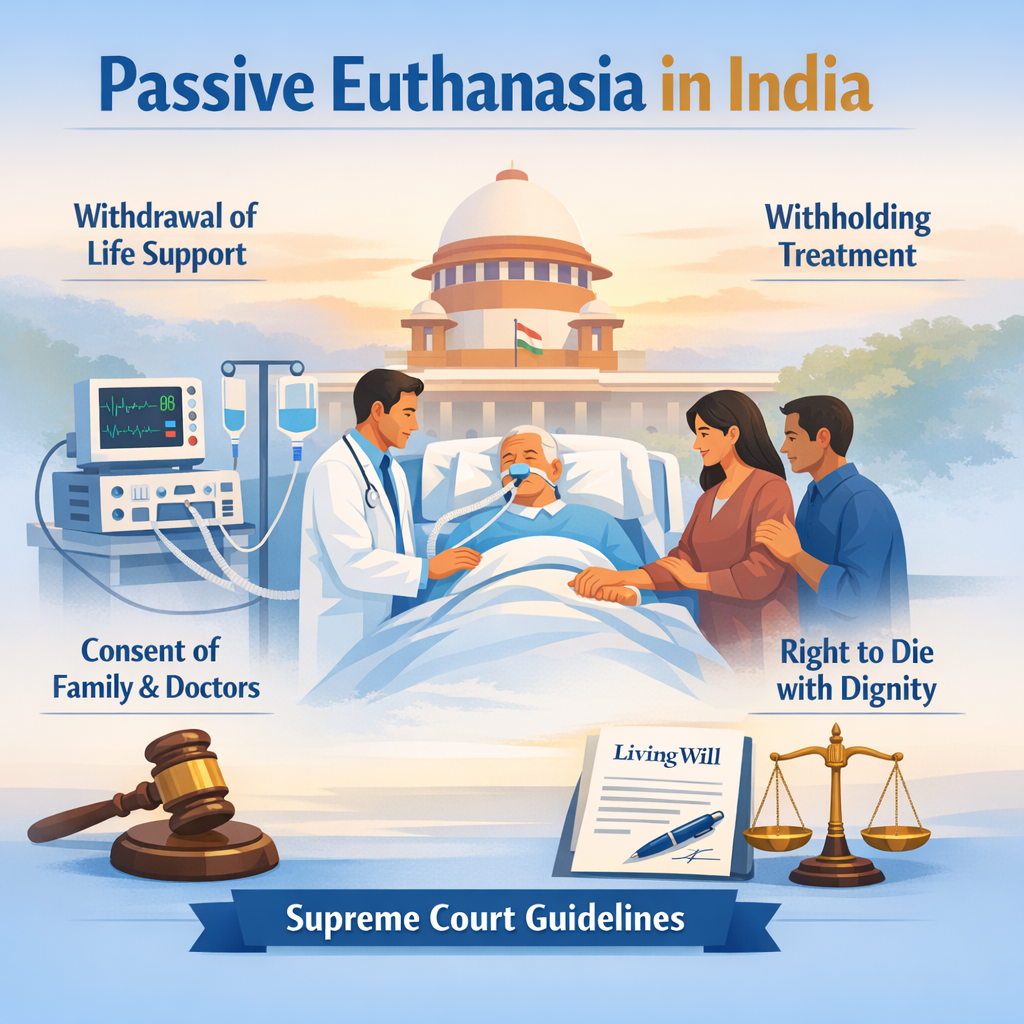
The topic of euthanasia, also known as the “right to die with dignity”, raises important ethical, medical and legal issues. Passive euthanasia has been a subject of discussion in India due to several key Supreme Court rulings. Passive euthanasia is defined as the act of withdrawing or withholding life-sustaining treatment from a patient who is terminally ill or in a permanent vegetative state, allowing the patient to die via the natural process of death. In contrast to active euthanasia in which an intentional act is performed to end the patient’s life, passive euthanasia is concerned with allowing the natural process of death when treatment cannot reasonably be expected to result in any meaningful recovery.
Understanding Passive Euthanasia
In discussing passive euthanasia, it is important to realize how it relates to dignity and autonomy. If a physician treats someone, prolonging their suffering with no reasonable hope of recovery from the treatment, that may violate his/her autonomy and/or dignity. Passive euthanasia should not be confused with any form of suicide or physician-assisted suicide. In the case of passive euthanasia, the physician does not directly bring about the death of the patient; rather, he/she recognizes that in some instances it is more humane to allow for natural death while ensuring the patient receives palliative care to reduce his/her discomfort.
The issue of passive euthanasia arises frequently in the context of terminal illness, irreversible coma, severe brain injury, or continued vegetative state when medicine confirms that recovery is virtually impossible.
Legal Status of Passive Euthanasia in India
Euthanasia has been a grey area in Indian law for many years. The conversation around euthanasia became more public and prominent through the case of Aruna Shanbaug v. Union of India and this case has changed India’s approach to end of life decisions.
The Case of Aruna Shanbaug (2011)
For more than 40 years Aruna Shanbaug was in a state of paralysis due to being raped while working as a nurse and an individual filed for euthanasia for her. The Supreme Court of India denied the individual’s application for active euthanasia but recognized that passive euthanasia can be allowed in limited circumstances. In allowing for the removal of life support systems with the approval of the High Court and medical professionals, the Court established procedural safeguards regarding these requests for the first time in India.
The Right to Die with Dignity
In its ruling on Common Cause v. Union of India, the Supreme Court of India clarified aspects related to this area by making it clear that there is a “Right To Die With Dignity” and that this right forms part of the “Right to Life” guaranteed by the Constitution of India under Article 21.
Passive Euthanasia has now been legally accepted as a result of this ruling, and the concept of a Living Will (Advance Directive) was introduced by the Court as part of this decision. A Living Will allows a person to indicate in advance that they do not wish to receive any kind of artificial life support should they enter into terminal or irreversible medical conditions.
One of the most significant aspects of this ruling was that it provides for recognition of patient autonomy and supports patients being treated in a dignified manner when end of life decisions are made.
Advance Directive and Living Will
A competent person may prepare an advance directive in the form of a written document that outlines their wishes related to medical care should that person become unable to make decisions about their medical treatment in the future. The Supreme Court has articulated certain procedural guidelines with respect to the creation and enforcement of advance directives and living wills, including:
An advance directive or living will must be made voluntarily by the person preparing it and must be executed by a competent adult. The advance directive or living will must clearly state the conditions under which a physician should withdraw life support from the patient.
The advance directive or living will must be witnessed, and it should be signed by a magistrate. The hospital will be required to establish a medical board to review and affirmatively determine the patient’s condition prior to complying with the advance directive or living will request.
Although there are various safeguards against the unauthorized use of these documents, some critics express concerns related to the complex nature and difficulty in effectively employing the advance directive and living will procedures, particularly in emergency medical situations.
Ethical Issues surrounding Passive Euthanasia
The idea of passive euthanasia continues to be a topic of much discussion among numerous people who continue to express differing viewpoints over its acceptableness in society.
Personal Freedom and Human Dignity
The most fundamental arguments supporting passive euthanasia exist in the form of personal freedom. People should have control over how their lives end as long as the measures they undertake do not inflict pain on another.
Relief from Continued Suffering
For example, in those circumstances where medical intervention has failed to provide a cure and only provides continued suffering, then the act of allowing an individual to die through passive euthanasia could be viewed as an act of compassion.
Concerns Regarding the Abuse of Euthanasia Laws
Some groups argue against any type of euthanasia due to concerns they may abuse such laws against individuals in certain classes including elderly persons, disabled persons, individuals who are unable to express their legal capacity.
Religious and Moral Considerations
Most religions consider the sanctity of human life and oppose any form of euthanasia. However, many ethical frameworks also recognize that allowing a person to die naturally, without any form of medical assistance which prevents that death, is morally acceptable.
The Ethical Role of Physicians and Euthanasia
Euthanasia can present some of the most difficult dilemmas physicians can face. As medical professionals, they need to weigh their obligation to preserve life against their obligation to reduce suffering.
The Ethics of Medicine Have Four Primary Tenets:
- Beneficence – Doing the best thing for the patient
- Non-maleficence – Not causing harm
- Autonomy – Allowing the patient to make their own choices
- Justice – The patient gets treated fairly
When considering whether to actively assist in a patient’s death via euthanasia, a physician must first assess whether the patient’s continued existence (because of medical interventions) will have a positive outcome for the patient or just cause suffering to be prolonged. Most hospitals tend to have a multidisciplinary (team approach) treatment committee who is responsible for ensuring the medical justification and ethical validity of the decision.
Misuse Protection Mechanisms
Indian laws dictate that before its possible to withdraw life-support from patients, there must be a number of safeguards in place to protect the patient from any form of mistreatment:
Confirmation of the patient’s medical status by means of a medical board
Confirmation of the existence of a patient’s living will or obtaining consent from relatives
Independent medical review by a medical board
That all required documentation and procedures have been complied with by the hospital.
The intent of these safeguards is to ensure that any actions taken are made as per proper procedures, the decisions made were medically warranted, and that no pressure or coercion was present at the time the decision was made.
Challenges to Society and Law
On a broader scope, passive euthanasia still faces many of the same challenges in the India that it has faced since its inception, including:
Lack of knowledge on living wills from the public
Complexity of procedure & documentation expectations
Ethical hesitance from physicians
Lack of cultural support for discussing end-of-life decisions.
In addition, in addition to the lack of knowledge regarding living wills, very few people in India have access to high quality palliative care, making them ill-prepared to have the proper conversations regarding dying with dignity.
One of the most difficult areas in medical ethics, law and dignity is passive euthanasia. The Indian judicial system’s response to the question of whether there is a right to die with dignity, and to allow passive euthanasia with strict conditions, has attempted to create a balance between protecting the sanctity of life and showing compassion to a person who is suffering from a condition that cannot be reversed.
The ability of individuals to use a living will gives them the ability to exercise their rights as an autonomous person and to have their wishes and choices respected. However, the effectiveness of living wills will be determined by the degree of public awareness, the modifications of procedures for using living wills and improvements to palliative care systems that are available to individuals at the end of life.
The issue of passive euthanasia illustrates clearly that society must provide the opportunity for individuals to pass away in dignity, without undue pain or suffering, as that shows not only progress within the law, but also more importantly, our commitment to humane societies.
Recent Posts