
Blog
Common Patent Rejection Reasons in India & How to Avoid Them
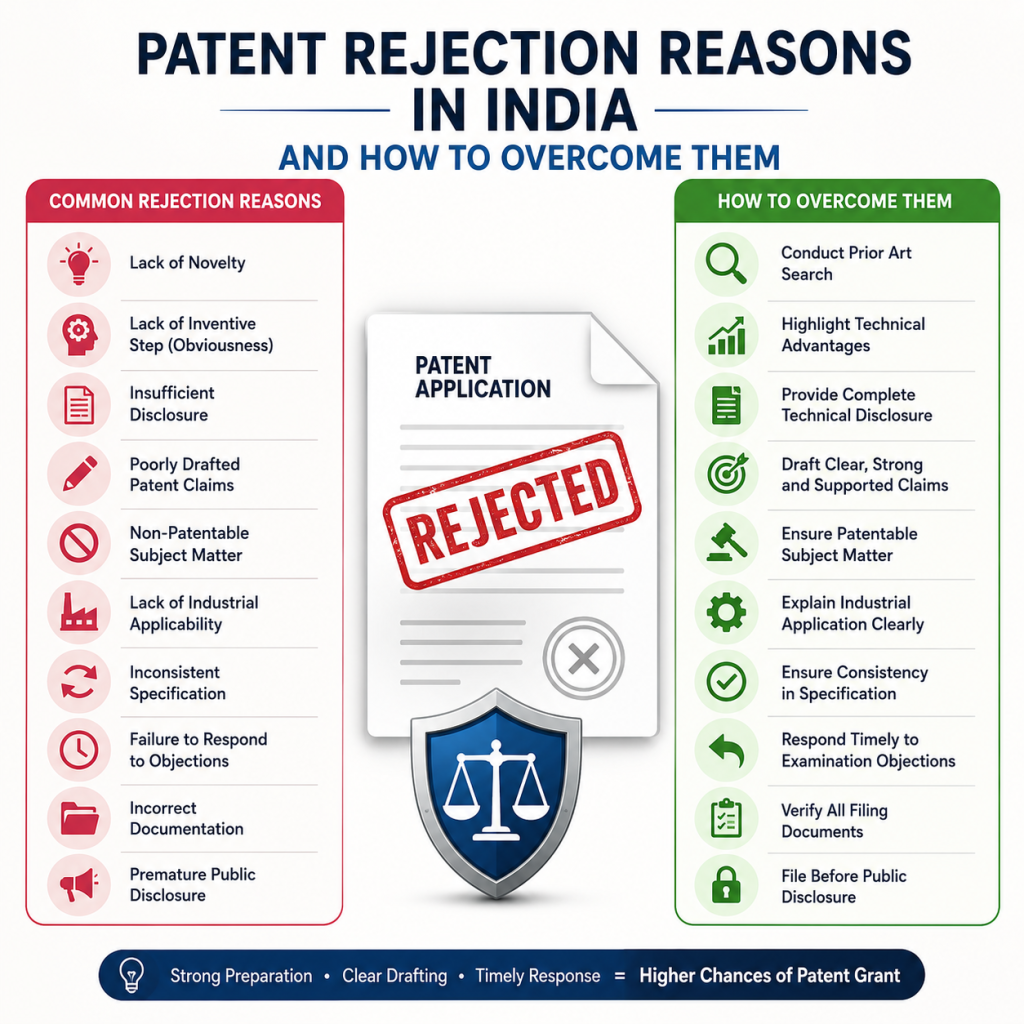
Patents protect innovative ideas by giving inventors exclusive rights over their inventions. However, obtaining a patent in India is not always straightforward. Many patent applications receive objections or are rejected because they fail to meet the legal and technical requirements prescribed under the Patents Act, 1970. A rejection does not necessarily mean your invention lacks value—it often indicates that the application needs stronger technical disclosure, better claim drafting, or a more effective response to the examiner’s objections.
Understanding the common reasons for patent rejection can help inventors, startups, researchers, and businesses prepare stronger applications and improve their chances of patent grant.
What Does Patent Rejection Mean?
Patent rejection occurs when the Indian Patent Office determines that an application does not satisfy one or more legal requirements for patentability. In many cases, applicants first receive a First Examination Report (FER) containing objections. If these objections are not adequately addressed, the application may ultimately be refused.
Common Patent Rejection Reasons in India
1. Lack of Novelty
Novelty is one of the most important requirements for patent protection. If the invention has already been disclosed anywhere in the world through patents, publications, public demonstrations, or online content before the filing date, it may fail the novelty test.
How to overcome it:
- Conduct a comprehensive prior art search before filing.
- Clearly explain how your invention differs from existing technologies.
- File the patent application before publicly disclosing the invention.
2. Lack of Inventive Step (Obviousness)
Even if an invention is new, it must not be obvious to a person skilled in the relevant technical field. If the examiner concludes that the invention is merely an obvious improvement over existing technology, the application may be rejected.
How to overcome it:
- Highlight the technical advantages of your invention.
- Demonstrate unexpected results or improved performance.
- Include comparative data where applicable.
3. Insufficient Disclosure
A patent specification must explain the invention in enough detail that a skilled person can reproduce it. Missing technical information, vague explanations, or incomplete descriptions can result in objections or rejection.
How to overcome it:
- Provide a complete technical description.
- Include drawings, flowcharts, or diagrams where necessary.
- Explain every important feature, component, and process.
4. Poorly Drafted Patent Claims
Patent claims define the legal scope of protection. Claims that are too broad, too narrow, ambiguous, or unsupported by the specification often attract objections from the patent examiner.
To understand why strong drafting is critical, read our guide on How Patent Drafting Impacts Patent Application Success – Expert Guide:
https://praesidiumip.com/blog/how-patent-drafting-impacts-patent-application-success-expert-guide
A well-drafted application significantly improves examination outcomes and strengthens long-term protection.
5. Non-Patentable Subject Matter
Certain inventions are excluded from patent protection under the Indian Patents Act. These include abstract ideas, business methods, mathematical methods, traditional knowledge, and inventions falling within statutory exclusions.
How to overcome it:
- Ensure your invention falls within patentable subject matter.
- Focus on the technical aspects and practical implementation.
- Seek professional guidance before filing.
6. Lack of Industrial Applicability
An invention must be capable of being made or used in an industry. If it has no practical application, the patent application may be rejected.
How to overcome it:
- Clearly explain the practical use of the invention.
- Describe its industrial or commercial applications.
- Include examples demonstrating usability.
7. Inconsistent Specification
Sometimes different sections of the patent specification contradict one another. Inconsistencies between the title, abstract, description, drawings, and claims create confusion during examination.
How to overcome it:
- Review the application carefully before filing.
- Ensure technical terminology is consistent throughout.
- Verify that every claim is supported by the description.
8. Failure to Respond to Examination Objections
After reviewing the application, the Patent Office issues an FER listing objections. Ignoring deadlines or submitting inadequate responses can lead to refusal of the application.
How to overcome it:
- Respond within the prescribed timeline.
- Address every objection with technical and legal reasoning.
- Amend claims where appropriate.
9. Incorrect Documentation
Missing forms, incomplete inventor details, incorrect declarations, or procedural errors may delay the application or contribute to rejection.
How to overcome it:
- Double-check all filing documents.
- Verify signatures, declarations, and supporting documents.
- Follow the Patent Office filing requirements carefully.
10. Premature Public Disclosure
Publishing, exhibiting, or selling an invention before filing a patent application can destroy novelty and affect patentability.
How to overcome it:
- File your patent application before public disclosure.
- Use confidentiality agreements when discussing the invention with third parties.
How to Improve Your Chances of Patent Approval
A successful patent application usually involves:
- Conducting a prior art search.
- Preparing a detailed and technically accurate specification.
- Drafting strong and well-supported patent claims.
- Including high-quality drawings where required.
- Ensuring compliance with the Indian Patents Act.
- Responding effectively to examination reports.
- Reviewing the application thoroughly before submission.
Importance of Professional Patent Drafting
Many patent rejections are caused not by weak inventions but by weak drafting. A professionally prepared patent application clearly explains the invention, defines the scope of protection through carefully drafted claims, and complies with legal requirements. This reduces unnecessary objections and improves the likelihood of patent grant.
Can a Rejected Patent Application Be Saved?
Yes. In many cases, applicants receive examination objections rather than an immediate final refusal. By responding with appropriate amendments, technical clarifications, and legal arguments, many applications proceed successfully through the examination process. However, the outcome depends on the nature of the objections and the strength of the response.
Best Practices to Avoid Patent Rejection
To improve the chances of patent approval:
- Conduct a prior art search before filing.
- Explain the invention in clear technical language.
- Include detailed drawings wherever required.
- Draft strong and well-supported patent claims.
- Avoid vague or overly broad descriptions.
- Ensure consistency throughout the application.
- Review the application carefully before submission.
- Seek professional drafting assistance.
Why Prior Art Search Matters Before Filing
A comprehensive prior art search helps identify existing patents, publications, and technologies related to your invention before filing a patent application. This process enables inventors to evaluate the novelty and inventive step of their innovation, reducing the likelihood of examination objections. It also helps refine patent claims and identify unique technical features that distinguish the invention from existing solutions. Investing time in prior art research can save both time and costs during the patent prosecution process.
Role of the First Examination Report (FER) in Patent Approval
The First Examination Report (FER) is a crucial stage in the Indian patent examination process. After reviewing a patent application, the examiner issues an FER highlighting any legal, technical, or procedural objections. Receiving an FER does not mean the patent has been rejected. Instead, it provides the applicant with an opportunity to clarify the invention, amend claims, or submit legal arguments supporting patentability. A timely and well-prepared response can significantly improve the chances of obtaining a patent grant.
Conclusion
Patent rejection is a common part of the patent examination process in India, but it can often be avoided through careful planning and thorough preparation. Understanding the common reasons for rejection—such as lack of novelty, obviousness, insufficient disclosure, weak claims, and procedural errors—helps inventors prepare stronger applications and respond effectively to examination reports.
A well-drafted patent application not only improves the chances of approval but also provides stronger legal protection and greater commercial value for your innovation.
FAQs
1. What is the most common reason for patent rejection in India?
The most common reasons include lack of novelty, lack of inventive step, insufficient disclosure, poorly drafted claims, and failure to meet legal requirements.
2. Can I refile a patent application after rejection?
Depending on the reason for rejection, you may be able to amend the application, file an appeal where applicable, or submit a fresh application if legally permissible.
3. Does receiving a First Examination Report (FER) mean my patent has been rejected?
No. An FER contains objections that the applicant can respond to. It is part of the examination process and not a final rejection.
4. How important are patent claims?
Patent claims determine the legal scope of protection. Well-drafted claims are essential for both obtaining a patent and enforcing patent rights.
5. Can a patent application be rejected because of poor drafting?
Yes. Unclear descriptions, inconsistent specifications, and weak claims can significantly reduce the chances of patent approval.
6. How can I improve the chances of patent approval?
Conduct prior art research, prepare a complete specification, draft clear claims, comply with legal requirements, and respond promptly to examination objections.
Get Expert Help Today
Need help preparing a claim chart or protecting your invention?
Contact PraesidiumIP
📞 +91 9958196337
📧 info@praesidiumip.com
Written By
Praesidium IP Team
Recent Posts