
Patent Preparation and Drafting Services
Patent Preparation and Drafting Services in India
Coming up with inventions isn’t just about having a great idea—it’s about protecting it too. Whether it’s cutting-edge tech, some unexpected lab discovery, or a clever gadget thought up in someone’s garage, the real shield for these ideas is what gets written down. Before launching a product or an app, you need solid descriptions. Think of these descriptions as armor; every carefully chosen word helps keep your idea safe from would-be copycats. The big tool here? A strong patent application. Honestly, it’s not just paperwork. It’s more like laying bricks to build a fortress around your creation. The value in an idea isn’t just the idea itself—it’s the fact that no one else can swoop in and take it. If you don’t write it out and claim it, even your best ideas can slip through the cracks. That one sheet of paper matters—it’s proof the idea is yours, and that counts for a lot.
If you’re hoping to create something and get it out in the world, you need a strong patent early in the process. Getting one isn’t just about knowing your tech inside out; it takes sharp legal smarts, careful planning, and thinking ahead to where your idea could go. Messy drafts leave gaps, and those gaps let others copy you down the line. But tight, well-written patents put up real barriers and help protect what you’ve made.
So, how do people actually write these patent applications? It starts with taking the idea and getting it down on paper, paying attention to every single detail and figuring out exactly what sets it apart. Inventors look back at older designs to see what’s different and make sure it stands out. Writing kicks off after digging through everything else that’s already been invented. Each claim gets hammered out step by step. The language? Super precise. Nobody submits anything until every single section clicks together, and all the formal requirements are met.
Expert Patent Preparation and Drafting Services
Secure your technological innovations with our expert patent preparation and drafting services. We specialize in transforming complex inventions into robust, legally sound intellectual property assets. Our experienced patent practitioners handle the end-to-end process, ensuring meticulous adherence to USPTO guidelines and international regulations.
We collaborate closely with inventors to conduct comprehensive prior art searches, establishing the novelty and non-obviousness of your creation. Our team excels at crafting precise patent specifications and technically accurate technical drawings. Most importantly, we strategically construct broad yet defensible patent claims designed to withstand potential patent prosecution challenges or infringement litigation.
Whether you require a provisional patent application to establish an early priority date, a non-provisional patent application for full utility protection, or a design patent application, we provide the legal and technical precision your business needs to protect its competitive edge.
A typical patent application includes:
· The name of the invention
· Background and field of the
invention
· A summary
· Detailed description
· Drawings or diagrams
· Claims (this is where you lay out
exactly what you’re protecting)
An abstract
A patent’s real power is in its claims—they spell out exactly what belongs to you. Get them right and your invention gets solid protection, broad enough to cover what matters, but sharp enough to avoid legal trouble. That’s always the goal: big coverage, but clear lines. Vague claims or wishful thinking? They’ll only come back to bite you. What you need are focused, well-written claims.
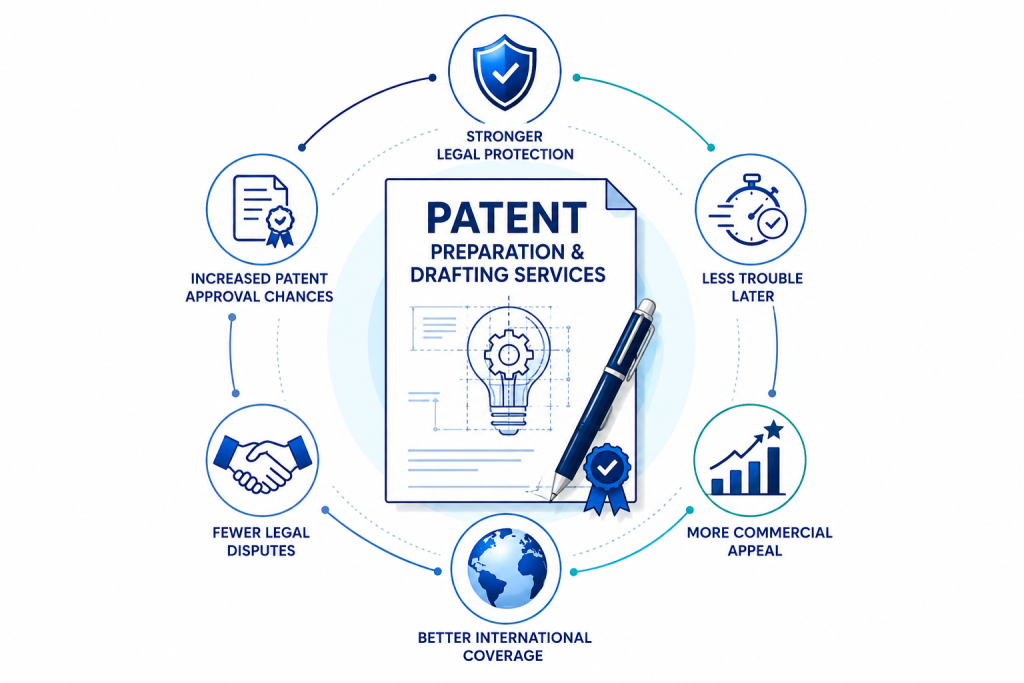
When inventors team up with professional patent drafters, good things happen
1. Stronger Legal Protection
Name what’s unique right away, and you have a patent that holds up. Tight claims shut down loopholes, so small changes by competitors don’t get through. The truly original stuff is nailed down early.
2. Less Trouble Later
Messy patents cause headaches—delays, arguments, rejections. But with clear claims, things move along much smoother. You sidestep a lot of pain down the line.
3. More Commercial Appeal
Investors and buyers care a lot about patents. Well-prepared filings quietly build trust and boost your company’s value—even if nobody’s saying it out loud.
4.Better International Coverage
Moving into other countries? Crystal-clear writing matters even more. Global rules are tough, and regulations can shift, so a tight patent travels well. Weak wording falls apart outside your home turf; strong claims make it through.
5. Fewer Legal Disputes
Vague language is a recipe for future fights, especially during big deals. Pin down your claims with exact words and most people know where the lines are. That means less squabbling later.
6.Stronger Patent Claims
Well-crafted patent claims define the scope of your legal protection. Carefully drafted claims reduce loopholes, making it harder for competitors to design around your invention while maximizing the value of your patent.
So, how does the drafting happen?
Patent drafting isn’t just filling out a form—it takes planning and sharp thinking. Every invention is a bit different, and the write-up has to fit the rules. No real shortcuts here. The biggest thing to get right: how you shape the details, not just what you list.
First, you start with real conversations. The inventor and drafter dig into the nuts and bolts—how it works, what it does, every possible use, and what’s genuinely new. Every standout feature gets flagged. Then comes prior art. Someone has to check what’s already out there. This step finds what’s truly new and steers how the patent is written. Writing the specification means laying out everything clearly enough that a pro in the field could understand or even make it themselves. It’s the backbone of the patent.
Now, the claims. This is where you draw your line—enough coverage to protect, but not so broad that you pick a fight you can’t win. Start basic, then add more claims to push the boundaries without stepping over them.
Drawings come next, if needed. Sometimes a diagram says what words can’t. Before sending anything off, go through every section again. Fix the mistakes, check the paperwork, and only then hit submit.
Drafting patents takes both technical skill and a sharp legal mind. It’s part engineering, part legal chess. That mix is what helps your patent stand up in court, handle new technology, and shut down copycats. The words you choose really do matter—it’s all about strategy, not storytelling. Most patent writers know their field, whether that’s engineering, biology, medical devices, software, or mechanics. Because they understand the details, they can spot what’s new and carve out claims that hit the mark. Pair that with strong legal sense and you get patents that do exactly what they should: they’re new, creative, useful, accurate, and clear—and tough enough to last.
Patents aren’t just a big deal in one industry—they matter everywhere. Whether you’re working in biotech, software, or something totally different, if your patent isn’t rock solid, you can’t shield your new idea, especially in a world that moves this fast.
Technology and Software
For software, it’s all about showing exactly how your invention actually works in practice. AI inventions? They need to solve a real tech problem, not just crunch data for the sake of it. Blockchain? Success lives or dies on clear explanations of the nuts and bolts. When you’re upgrading digital security, you need to zoom in on real system changes—not just cosmetic fixes. And if you’re handling big data, it helps to tie those methods back to actual hardware upgrades. That’s what makes the patent stronger.
Pharma and Biotech
If you’re drafting for pharma or biotech, details are everything. Every chemical, combination, gene tweak, drug, treatment, and test has to be described just right. The rules here are pretty ruthless—only the patents with the clearest, most thorough details survive.
Mechanical and Engineering
Factories can’t run and engines can’t be built until someone sketches out all the details—and I mean every detail. The genius, more often than not, lives in those first drawings, long before any machine gets made.
Electronics and Telecommunications
Electronics patents are all about circuits, how devices talk, how chips work, and the software that drives the hardware. None of those words can be vague—small mistakes could mean massive, expensive headaches later. In this line of work, every term matters and timing’s everything, since the tech moves forward in huge leaps.
Startups and New Companies
Startups need patents if they want investors to pay attention. That first batch of IP? It’s the backbone for everything that comes next. When you own your inventions, you get leverage for the road ahead, plain and simple.
Patent Drafting Services in India
India’s changing so fast it’s hard to keep up. More startups launch, labs test new ideas around the clock, factories keep growing, and everyone wants patents to match. Indian patent services cover all these needs—from small startups to big pharma, from solo inventors to global multinationals.
With India constantly tweaking its laws for new tech, patents have turned into a must-have. Innovation isn’t just nice to have—it’s essential if you want to stick around. And if you’re not protecting your inventions, you’re taking a risk you probably can’t afford. Laws keep moving, and nobody can just watch from the sidelines.
Indian experts now handle not just local filings, but also international ones through the PCT. They’re fast when office actions pop up, know how to tighten claims, and steer around traps as cases move forward.
Common Challenges in Patent Drafting
Defining Broad Yet Valid Claims
Claims are tough. Go too broad and you lose support, too narrow and you don’t cover enough. You need claims that match your invention exactly, so they actually work in court and out in the real world. The best claims tie right back to the detailed description.
Balancing Technical Info With Clarity
You want patents to have all the technical details needed, but not so much that readers get lost. Leave out too much, and the holes will sink you. The real trick is layering in complexity without losing people—make it deep, but keep it clear.
Allowing for Future Tweaks
Good inventors know you have to plan for change. The strongest patents protect against small, sneaky tweaks that others might try to get around the invention. If you include these variations early on, you end up with broader protection and fewer headaches from copycats.
Handling Different Country Rules
Countries all have their own rules for patents. So, how you write one depends on where you’re filing. Patent offices don’t always think the same way, so you need to adjust, especially if you want to protect your idea worldwide. Tailoring drafts for each place makes a world of difference.
So let our experts turn your innovation into a legally protected asset.