
Blog
Difference Between Judicial Separation
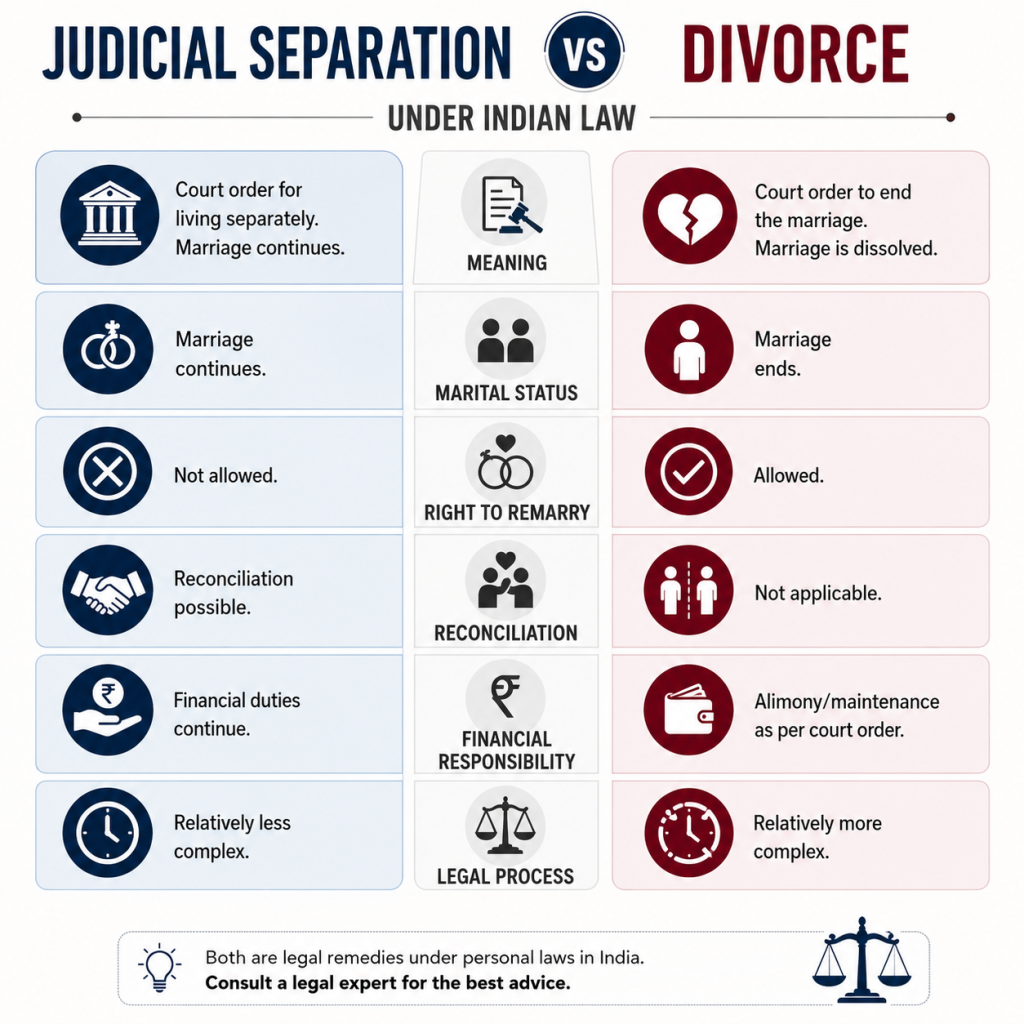
Marriage is considered a sacred union in India, a lifelong bond built on trust, companionship, and mutual respect. However, not all marriages follow a smooth path. Sometimes, due to irreconcilable differences, cruelty, desertion, or constant conflict, couples find it impossible to live together under the same roof.
When a marriage faces severe turmoil, Indian law does not leave the spouses stranded without options. Family law in India provides two primary legal remedies to handle marital disputes: Judicial Separation and Divorce.
While both remedies offer legal relief to troubled couples, they serve entirely different purposes and lead to distinct legal outcomes. For anyone navigating matrimonial discord, understanding the difference between judicial separation and divorce under Indian law is crucial before taking a step toward the family courts.
This comprehensive guide breaks down the legal nuances, grounds, procedures, rights, and financial implications of both options in a simple, professional manner.
Understanding Judicial Separation Under Indian Law
What is Judicial Separation?
Judicial separation is a temporary legal relief granted by a family court that allows a married couple to live apart without officially dissolving their marriage. Think of it as a “legal pause button” or a formal cooling-off period.
Under a decree of judicial separation, the couple remains legally married in the eyes of the law, but their matrimonial obligation to cohabit (live together) is suspended. It provides troubled couples with space and time to rethink their relationship, protect their mental peace, and evaluate whether they want to reconcile or permanently sever ties.
Legal Provisions: Judicial Separation under Hindu Marriage Act
Under family law in India, specific statutes govern different religions. For Hindus, Buddhists, Jains, and Sikhs, the relevant law is the Hindu Marriage Act, 1955 (HMA).
Section 10 of the Hindu Marriage Act, 1955 deals with Judicial Separation. It states that either party to a marriage, whether the husband or the wife, may present a petition praying for a decree for judicial separation on any of the grounds specified in Section 13(1) of the Act.
Once the court passes a decree for judicial separation, it is no longer obligatory for the petitioner to cohabit with their spouse.
Understanding Divorce Under Indian Law
What is a Divorce?
Unlike judicial separation, a divorce is the ultimate and final legal dissolution of a marriage. It is a permanent legal remedy that completely breaks the matrimonial bond.
When a court grants a decree of divorce, the legal status of the parties changes from “married” to “unmarried” or “divorced.” The marriage ceases to exist in the eyes of the law, and all mutual matrimonial rights and obligations come to a permanent end.
Legal Provisions for Divorce
Divorce laws in India are codified under separate personal laws based on religion:
Hindu Marriage Act, 1955: Section 13 (Contested Divorce) and Section 13B (Divorce by Mutual Consent) govern Hindus, Sikhs, Jains, and Buddhists.
Special Marriage Act, 1954: Section 27 and Section 28 govern civil, inter-caste, and inter-faith marriages.
Indian Divorce Act, 1869: Governs Christian marriages.
Dissolution of Muslim Marriages Act, 1939: Governs the dissolution of Muslim marriages along with uncodified Muslim personal law.
Grounds for Judicial Separation vs Divorce
The statutory grounds for seeking judicial separation and a contested divorce under the Hindu Marriage Act are virtually identical. The same acts of misconduct or circumstances that justify a permanent divorce can also justify a temporary legal separation.
Common Legal Grounds
Under Section 13(1) and Section 10 of the HMA, a spouse can petition the court based on the following grounds:
Cruelty: Physical or mental torture that causes a reasonable apprehension in the mind of the spouse that living together is harmful or injurious.
Desertion: One spouse abandoning the other without a reasonable cause and without consent for a continuous period of not less than two years.
Adultery: The spouse voluntarily having sexual intercourse with any person other than their partner after the solemnization of marriage.
Conversion: One spouse ceasing to be a Hindu by converting to another religion.
Insanity / Unsound Mind: The spouse suffering continuously or intermittently from a mental disorder of such a kind that the petitioner cannot reasonably be expected to live with them.
Virulent Leprosy: A severe, incurable form of leprosy suffered by the spouse.
Venereal Disease: The spouse suffering from a communicable form of venereal disease (such as HIV/AIDS).
Renunciation of the World: One spouse entering a religious order and renouncing worldly affairs.
Presumption of Death: The spouse not being heard of as being alive for a period of seven years or more by persons who would naturally have heard of them.
Additional Grounds Available Exclusively to the Wife
Indian law provides extra protection to women. A wife can seek judicial separation or divorce on these additional grounds:
Bigamy: The husband marrying again while his first marriage is still subsisting.
Guilty of Offenses: The husband being found guilty of rape, sodomy, or bestiality after the marriage.
Non-Resumption of Cohabitation after Maintenance Decree: If a decree for maintenance under Section 18 of the Hindu Adoptions and Maintenance Act or Section 125 of the CrPC/BNSS was passed against the husband, and the parties have not cohabited for one year or more.
Repudiation of Marriage: If the wife was married before attaining the age of 15 years and she repudiated the marriage after attaining 15 years but before turning 18.
Comparative Analysis: Difference Between Judicial Separation and Divorce Under Indian Law
To grasp the operational differences between these two family law remedies, let us look at a comprehensive comparison table:
| Comparison Criteria | Judicial Separation | Divorce |
| Basic Meaning | A court decree suspending the matrimonial obligation of living together without dissolving the marriage. | A court decree that permanently dissolves the marriage contract. |
| Legal Status of Spouses | The parties remain legally husband and wife. | The parties cease to be husband and wife and become single/divorced. |
| Right to Remarry | Neither party can remarry. Remarrying during this period amounts to Bigamy (punishable under Indian law). | Both parties are completely free to legally remarry after the appeal period expires. |
| Possibility of Reconciliation | High. The primary objective is to give a second chance. The decree can be rescinded easily by the court if the couple reconciles. | Low/Nil. To undo a divorce, the couple must undergo a fresh, legal remarriage ceremony. |
| Court Process & Requirements | Can be filed at any time after marriage. No mandatory waiting period of one year is required to file the petition. | Generally cannot be filed within the first year of marriage (except in cases of exceptional hardship). |
| Financial Responsibilities | Spouses may maintain certain financial obligations. Interim and permanent alimony can be claimed. | Mutual financial liabilities end, except for court-ordered permanent alimony or lump-sum settlements. |
| Property & Inheritance Rights | Spouses generally retain their right to inherit each other’s property if one dies intestate (without a will). | All legal inheritance rights as a spouse are permanently terminated upon the passing of the final decree. |
| Social and Mental Impact | Less social stigma; leaves a window of hope open for the family and children. | Carries finality; can involve high emotional stress and social stigma during the transition. |
Rights of Husband and Wife: Maintenance, Custody, and Property
When a marriage fractures, key legal protections come into play regarding financial survival, children, and assets.
1. Maintenance and Alimony
A common misconception is that a wife cannot claim maintenance if she is only seeking judicial separation and not a divorce. This is incorrect.
Under family law in India, a wife is entitled to claim both interim maintenance (during the pendency of the court case) and permanent alimony/maintenance under both setups:
Section 24 of the HMA: Allows either spouse (husband or wife without independent income) to claim maintenance pendente lite (during the litigation) for both separation and divorce cases.
Section 25 of the HMA: Empowers the court to order permanent alimony and maintenance at the time of passing the decree or any time subsequent to it, whether it is for judicial separation or divorce.
2. Child Custody Implications
Child custody is decided based on the welfare of the child, which is the paramount consideration for Indian courts.
During Judicial Separation: Since the parents are living separately but are still married, the court will grant temporary custody, visitation rights, or joint custody arrangements. The non-custodial parent is legally obligated to pay child maintenance.
During Divorce: The final decree of divorce clearly specifies permanent custody parameters, comprehensive visitation rights, and long-term financial provisions for the child’s education and upbringing.
3. Property and Inheritance Rights
Property rights differ drastically between the two remedies:
In Judicial Separation: If the husband dies without leaving a will (intestate) while a decree of judicial separation is in effect, the wife remains his legal wedded spouse. Under the Hindu Succession Act, 1956, she is a Class-I heir and inherits her rightful share of his property.
In Divorce: Once the divorce decree is signed, the woman loses her status as a wife. She has no claim over her ex-husband’s self-acquired or ancestral property if he dies intestate. She does, however, retain full ownership of her Stridhan (gifts, cash, and jewelry given to her at the time of marriage).
Reconciliation Possibilities and the Legal Process
Returning to Normalcy from Judicial Separation
The law prefers preservation of marriage over its destruction. If a couple under a decree of judicial separation resolves their issues, they do not need to get remarried.
Under Section 10(2) of the Hindu Marriage Act, the court may, upon the application of either party and if it is satisfied that it is just and reasonable to do so, rescind (cancel) the decree of judicial separation. Once rescinded, the couple can resume living together with all matrimonial rights fully restored.
The Time Duration and Court Path
The procedural steps for both filings require filing a formal petition in the local District Family Court where the marriage was solemnized, or where the respondent currently resides, or where the couple last lived together.
Judicial Separation Process: A petition can be filed immediately when disputes arise. There is no statutory bar requiring a one-year wait after the wedding day. The court evaluates evidence of cruelty, desertion, etc., and grants the decree.
Divorce Process: Generally, under Section 14 of the HMA, a divorce petition cannot be filed before one year of marriage has passed, unless exceptional hardship to the petitioner is proven.
Important Nexus: If a decree of judicial separation is passed, and the couple fails to resume cohabitation for a continuous period of one year or more after the decree, this failure itself becomes an absolute ground for either spouse to apply for a permanent divorce under Section 13(1A)(i) of the Hindu Marriage Act.
Real-Life Practical Examples and Legal Scenarios
To help common readers understand how these concepts apply in daily life, let’s explore two realistic scenarios.
Scenario A: Choosing Judicial Separation
The Case of Amit and Priya Amit and Priya have been married for three years. Due to constant interference from extended family and severe compatibility issues, they find themselves fighting daily, which severely damages their mental health. Priya wants to live separately to find peace, but both families belong to a conservative social circle where divorce is heavily stigmatized.
Furthermore, Priya holds out a small hope that Amit will realize his mistakes once they spend time apart. Instead of opting for a complete divorce, Priya files for a Judicial Separation on the grounds of mental cruelty.
The Outcome: The court grants the decree. Priya moves into her own apartment, and Amit pays her monthly maintenance. They are legally protected from charges of desertion. They have the space to introspect without the pressure of a final break-up.
Scenario B: Choosing Divorce
The Case of Rajesh and Sneha Rajesh and Sneha have been married for five years. Rajesh discovers definitive proof that Sneha is engaged in an ongoing extramatrimonial relationship (adultery) and has abandoned their home to live with her partner. She openly states she has no intention of ever returning.
Rajesh knows there is absolutely no room for reconciliation, trust is completely broken, and he wishes to clear his legal status so he can move on with his life and eventually remarry.
The Outcome: Rajesh skips judicial separation entirely and directly files a petition for a contested Divorce on the grounds of adultery and desertion. After examining the evidence, the court dissolves the marriage permanently. Rajesh is now free to start a new life.
When is Judicial Separation or Divorce the Better Option?
Choosing between Judicial Separation vs Divorce depends on your personal circumstances, emotional state, religious beliefs, and long-term life goals.
When Judicial Separation is a Better Option
Religious and Moral Beliefs: If your personal conscience or religious values strictly prohibit divorce, separation allows you to live independently without violating those beliefs.
A Hope for Reconciliation: If you feel the problems are temporary, driven by external stress, and can be resolved with time and marriage counseling.
Financial and Medical Support: If one spouse relies heavily on the other for medical insurance, health benefits, or specific pension schemes that would terminate upon a divorce.
Tax and Property Preservation: When couples want to keep estate and property planning intact for the sake of their children’s financial security.
Sparing Young Children: To give young children time to adjust to changing parental dynamics gradually, rather than through a sudden, disruptive divorce shock.
When Divorce is More Suitable
Extreme Abuse or Danger: If there is severe domestic violence, physical abuse, or systemic torture, a permanent, clean break is essential for personal safety.
Desire to Remarry: If you want to find love again and establish a new legal family setup.
Complete Breakdown of Trust: When acts like unrepentant adultery or permanent conversion to another faith leave absolutely zero scope for emotional repair.
Need for Finality: When you want full closure and want to permanently stop the litigation and emotional drain associated with a dead marriage.
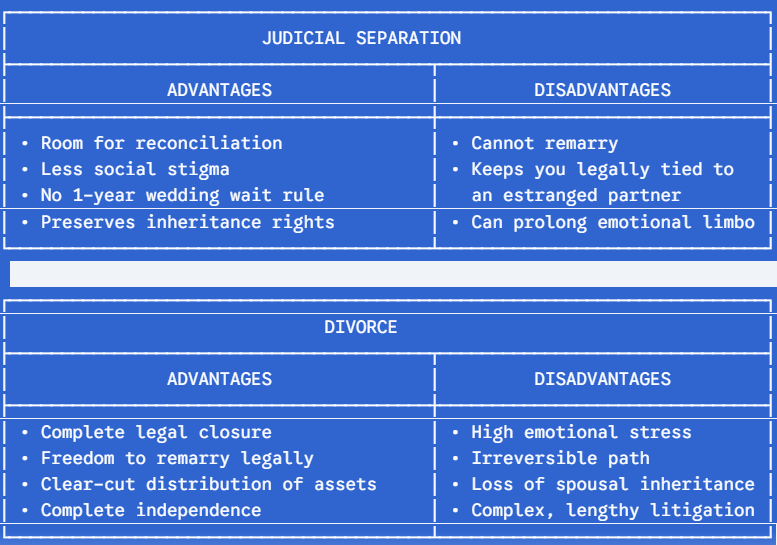
Advantages and Disadvantages at a Glance
Conclusion: Making the Right Legal Move
Navigating marital conflict is an exhausting experience, both emotionally and financially. When things turn sour, you do not have to rush into a final divorce if you are not ready for its permanent consequences. At the same time, you shouldn’t force yourself to stay in an abusive environment when a legal exit via divorce is accessible.
The choice between Judicial Separation vs Divorce hinges entirely on your unique situation—whether you need a temporary pause to evaluate options or a permanent, final break to start anew. Because family laws in India involve intricate procedural steps, maintenance rules, and asset distributions, making these decisions blindly can compromise your legal rights.
Need Expert Guidance on Your Family Law Matter?
If you are facing marital issues and are confused about whether to file for judicial separation or divorce, do not handle it alone. Every case requires a personalized strategy to protect your future, your finances, and your children.
Frequently Asked Questions (FAQs)
1. Can judicial separation lead to divorce?
Yes. If the family court passes a decree for judicial separation, and the couple does not resume living together (cohabiting) for a continuous period of one year or more after the decree, either spouse can use this as a direct, independent ground to file for divorce under Section 13(1A)(i) of the Hindu Marriage Act.
2. Can spouses live separately without getting a divorce or judicial separation?
Yes, couples can choose to live separately through a informal, mutual understanding, often called a de facto separation. However, doing so without a legal document or court decree carries risks. The abandoned spouse might file a case alleging desertion, or disputes may arise regarding maintenance and child custody without clear legal guidelines.
3. Is alimony available after a judicial separation?
Yes. Under Sections 24 and 25 of the Hindu Marriage Act, the court has full authority to grant both interim maintenance during the court case and permanent alimony/maintenance at the time of passing a decree of judicial separation. The right to seek financial maintenance is fully protected.
4. Can couples reconcile after a judicial separation?
Absolutely. One of the main purposes of judicial separation is to leave the door open for reconciliation. If the couple resolves their issues, they can jointly move an application under Section 10(2) of the HMA. If satisfied with their intent, the court will rescind the separation order, allowing them to live together as husband and wife again.
Get Expert Help Today
Need help preparing a claim chart or protecting your invention?
Contact PraesidiumIP
📞 +91 9958196337
📧 info@praesidiumip.com
Written By
Praesidium IP Team
Recent Posts