
On 16 November 2025, the small town Malegaon in Nashik district was shaken by a horrifying crime where a four-year-old girl was allegedly raped and brutally murdered in Dongrale village. This news literally shaked the nation and invariably sparked mass outrage where thousands of residents of Malegaon joined a shutdown (“bandh”), marching in grief of this crime and demanding the death penalty for the accused. Families and communities across religious lines came together showing that pain has no divisions. The state minister promised a fast-track court in this case and appointed senior advocate Ujjwal Nikam as public prosecutor. But if we are to analyse amid the protests, there’s a much deeper and uncomfortable question which is: does this case expose systemic failures in our justice machinery or is it a rare aberration?
Demand for Speedy Trial but Are We Getting Substance
The government assured a fast-track trial and pursuit of capital punishment is not new in such heinous rape cases. But it is also important to understand that fast-track courts often struggle with overloading of cases, procedural delays, and resource constraints so turning promises into realities is also a challenge. There is also a dangerous pattern unfolding when the public demands harsh punishment, political leaders promise it and then courts feel pressured as this would mean that the justice system is reactive to outrage and not always fair or balanced in its approach.
Appointing a senior public prosecutor may help but it’s not a silver bullet because effective prosecution wholly depends on investigative agencies, forensic work, and protection of witnesses. In these kinds of emotionally charged cases there is immense pressure on police and judiciary, it is not just to convict the accused, but to be seen doing so and without great systemic safeguards that kind of performance pressure would be a risk which could hamper due process of law.
Trust Deficit and Marginalized Voices
Malegaon’s shutdown showed communal solidarity, but we often see that these marginalized victims or minority communities from rural areas lack access to justice. Their voices are often being sidelined once media attention dies down. It is important to understand that a justice system should not only deliver verdicts but should also rebuild trust in institutions.
The Larger Landscape
This tragedy cannot be viewed in isolation in recent years we have seen a string of distressing cases in India which are invariably reflecting structural weaknesses in how sexual violence cases are being handled in our system.
● The Dhing gang rape in 2024 where a 14-year-old school going girl in Assam was abducted and allegedly raped by several men.
● The Badlapur school case of 2024 where two girls of four-year-old were reportedly abused for several days by a school cleaner which led to mass protests and also raised demands for institutional reforms.
● The Varanasi gang rape in 2025 was also one of the bad one where a 19-year-old woman was allegedly assaulted for several days by more than twenty men.
● The Kolkata trainee doctor case one of the heinous crime where a police volunteer was convicted for raping and murdering this case triggered nationwide protests and invariably highlighted the vulnerability of women even in professional workspace.
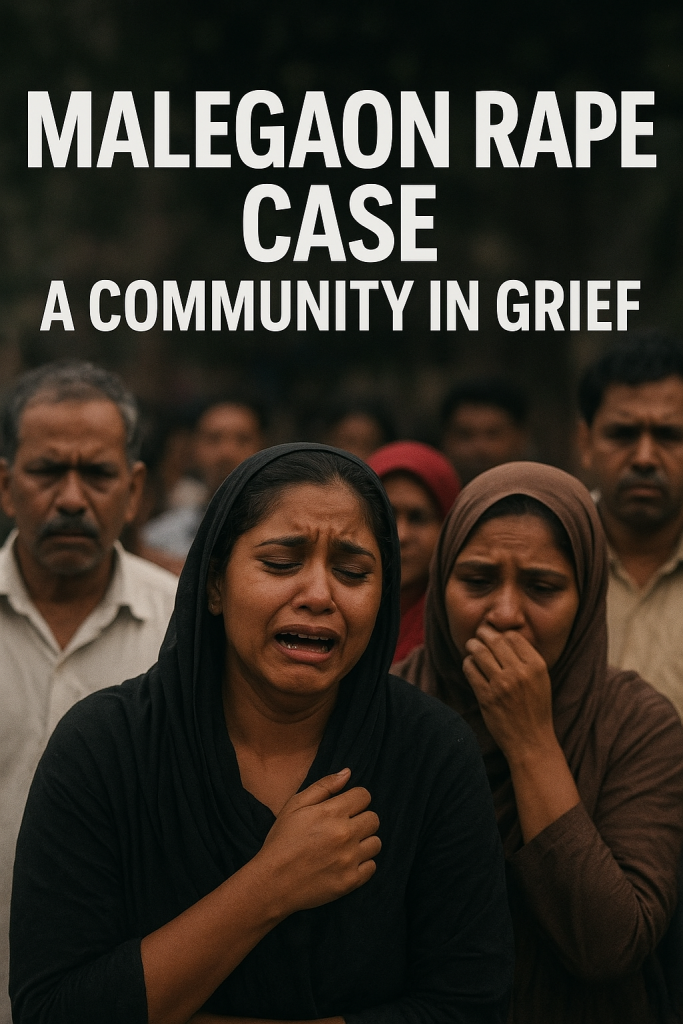
These cases and many more cases like these invariably point out recurring issues such as inadequate prevention, delayed or opaque investigations, weak victim protection, and also reactive political responses; and behind every such headline there is a child, a woman, a family. If we see this Malegaon rape case, it’s the four-year-old girl whose life was cut tragically short; the pain of her terrified parents; her community’s collective heartbreak and for them justice is not just a legal process, it’s deeply personal. And then there are other cases where the teenage girl in Assam was traumatized; the young medical student whose future was stolen in a few minutes; the schoolgirls in Badlapur whose innocence was violated.
These stories remind us that rape is never just a statistic its much more then that as it invariably tears social fabrics, shakes public trust, and demands much more than swift headlines, most importantly it demands systemic change.
A Critical Call for Reform
It is very crucial to strengthen investigation, as for fast convictions cases are to be investigated properly and for executing this police departments need more resources, training, and forensic labs so that evidence is collected and preserved properly. Apart from this Independent Specialised Prosecution Units should also be created for dealing with cases of sexual violence which are staffed by specialists having victim-centric approaches. Moreover, courts must ensure that survivors and their families get legal, psychological, and physical protection as without that many may be too afraid to speak the real facts.
It is also important to note that legal reforms alone aren’t enough, we need to work on community education, awareness, and social change in order to prevent gender-based violence, especially in rural and marginalized areas. Governments and courts must be accountable and work towards fairness and transparency as public reporting on pendency, conviction rates, and victim redressal mechanisms is also vital.
Conclusion
The Malegaon case is a very heartbreaking incident and the community’s demand for justice is powerful. Yet, if our collective response stops at outrage and punishment, we risk repeating the same cycle. This should work towards structural reform, not just on simply performative justice. It is essential to note that justice never lies in winning a case rather it lies in rebuilding trust, protecting and working for the vulnerable section of society, preventing sexual violence to its core before it even happens and ensuring that every survivor’s voice is heard and respected by everyone. Only then can we truly honor the memory of the little girl in Malegaon and work toward a safer and a just society.